The news has shown us all some disturbing stories this week. I suppose they aren’t really “particularly” disturbing. After all, there will be more next week. Anyway, I’m not going to talk about those things here. I’m going to ignore them in favor of reminding myself, and hopefully you, of something much more important.
We have work to do.
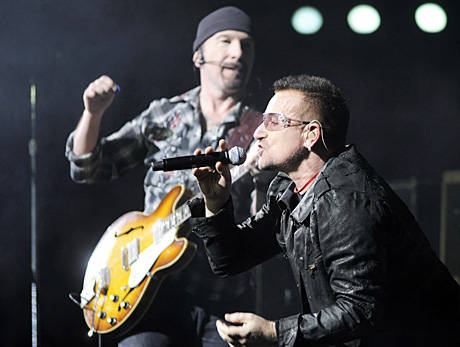
Look closely at his hands. The gesture means “Fear not."
There will always be turmoil in the world. Obviously. And of course. Yet everything is as it must be. Chaos is a necessary condition for evolution. And evolution is what we are all here for. It may not always seem like it, but that’s a good thing too. Fear not. Everything is okay.
It’s a very old symbol,
carried down across many cultures for one reason.
Because it’s true.
Everything is Okay.
Fear not.
At the end of each day on planet earth, the net-positive quietly outweighs the net-negative, bombastic and intimidating as it may be. Even if we can’t easily see it, even if it doesn’t make the news, everyday a man goes without food so that another may eat, a woman goes without rest so that a child may sleep, and entire communities volunteer for hardship so that others may reach higher potentials.
Every day a great step is taken.
How great? Let’s take a step back for some perspective. No, a little further… a little more… Okay that’s far enough. Let’s look for a moment at the really big picture.
What we call history, all the way back to the Big Bang, is really the story of growth. We exist within an ongoing process in which simple things grow into more complex things capable of more and more over time. On this particular island in space, simple elements evolve into breathable air and sustaining water. Simple cells evolve into plants and animals. Autonomous animals evolve from creatures of instinct to creatures of reason. All of that growth happened over billions of years.
The next step? Over the last hundred thousand years or so - a grain of sand on the beach of time - creatures of reason have begun to evolve into beings with the ability to recognize an aspect of themselves we generally refer to as spirit or “soul.”
Evolution does not happen overnight. Fungus does not suddenly become a tree. Instinct does not suddenly become reason. And humankind does not suddenly become whatever it is we are working our way towards in an instant. Rather, steps taken in the direction of higher states come from acts of courage born out of necessity. Some lowly worm had to climb high into the trees before the first butterfly could come. A fish had to venture onto the land before anything walked. And some human being had to trust in something about himself which he could not see or point to before he could do something no animal ever could – take a stand on principle.
Animals do not rush into burning buildings or throw themselves onto live grenades that fall among their comrades. Nor does every man. But with each step taken, more and more will be able say I do not need to fear because death has no dominion over me.
Courage is the key. Where do human beings get their courage? Faith. Not the faith of dogma or religion (although such things can sometimes help). Ultimately, any act of courage comes from an understanding, whether fully realized in a moment or something more subtle, that we are more than our current situation makes it seem.
A baby bird can’t really know what’s going to happen the first time it jumps out of a nest high in tree. But he suspects something about himself, a potential unrealized while he sits and waits.
After that first act of faith, birds can fly at will.
Here's another reason why people should read history.
In fact, I would like to know how it is possible that I made it through grade school without hearing this story, without a single history teacher realizing that this would make every student a little less jaded, a little less self-absorbed, a little more courageous, and probably even a lifelong fan of American History.
Teddy Roosevelt, the man who preserved our nation's beloved national parks so they would be nice and clean for our beloved oil companies when they arrived to correct the height of the mountains a century or so later, was SHOT in the CHEST, THEN delivered a 90 minute speech.
Many years later, a very famous male-model of windbreakers and hair products named James Dean, said...
"Dream as if you'll live forever, live as if you'll die today."
He wasn't talking about Roosevelt at the time. In fact, he was probably just trying to get laid, but still, the sentiment is spot on.
Because as he stood on that podium, literally bleeding from the bullet of a fresh, and nearly successful assassination attempt, Teddy Roosevelt was still living his life, still leading, trying to be a guide toward a better direction. His words on that day, kind of put things in perspective right now. As history can sometimes do.
Here's some of what my new favorite President of the United States said before they pried him off the stage to get the freakin' bullet out of his chest.
"I am going to ask you to be as quiet as possible for I am not able to give the challenge of the bull moose quite as loudly. Now, I do not know who he was or what he represented. He was a coward. He stood in the darkness in the crowd around the automobile and when they cheered me, and I got up to bow, he stepped forward and shot me in the darkness.
Now, friends, of course, I do not know, as I say, anything about him; but it is a very natural thing that weak and vicious minds should be inflamed to acts of violence by the kind of awful mendacity and abuse that have been heaped upon me for the last three months by the papers in the interest of not only Mr. Debs but of Mr. Wilson and Mr. Taft.
Friends, I will disown and repudiate any man of my party who attacks with such foul slander and abuse any opponent of any other party; and now I wish to say seriously to all the daily newspapers, to the Republicans, the Democrat, and Socialist parties, that they cannot, month in month out and year in and year out, make the kind of untruthful, of bitter assault that they have made and not expect that brutal, violent natures, or brutal and violent characters, especially when the brutality is accompanied by a not very strong mind; they cannot expect that such natures will be unaffected by it.
Now, friends, I am not speaking for myself at all, I give you my word, I do not care a rap about being shot; not a rap.
I have had a good many experiences in my time and this is one of them. What I care for is my country. I wish I were able to impress upon my people -- our people, the duty to feel strongly but to speak the truth of their opponents. I say now, I have never said one word one the stump against any opponent that I cannot defend. I have said nothing that I could not substantiate and nothing that I ought not to have said -- nothing that I -- nothing that, looking back at, I would not say again.
Now, friends, it ought not to be too much to ask that our opponents -[speaking to some one on the stage]-I am not sick at all. I am all right. I cannot tell you of what infinitesimal importance I regard this incident as compared with the great issues at stake in this campaign, and I ask it not for my sake, not the least in the world, but for the sake of common country, that they make up their minds to speak only the truth, and not use that kind of slander and mendacity which if taken seriously must incite weak and violent natures to crimes of violence. Don't you make any mistake. Don't you pity me. I am all right. I am all right and you cannot escape listening to the speech either."
If you could play just one of your favorite songs... for Mozart... What would you choose?
"How can that be?" Mozart asked after a pretty long pause.
How would you explain...
Mozart and I were standing on the front balcony of my home, a corner apartment overlooking the boats in Marina Del Rey. Christie had fed us a lovely chicken dinner shortly after we got home. She had already determined that this odd little man was one of the most committed actors I had ever brought home, and had long since gone to bed. Across the water, the glow of the city warmed the sky from beneath, but Mozart was looking higher, almost straight up at the flashing navigation lights of a 737 headed East from LAX. I had just told him there were about 150 souls aboard.
Tough question to answer for a man who died in 1790. Where do you even start? The combustion engine? The Wright brothers?
...all of this...
I also had a more immediate concern. The static tingle of a building plasma burst was raising the hair on my arms as it gathered force in the air just beyond this balcony. If Mozart felt it, he probably just thought it was another bizarre aspect of everyday life in my world. But I knew what it was. I had seen it before. Whatever had brought him to this time and place was coming back for him very soon. Maybe in just minutes.
I decided the best way to answer any question from here on would be to just yank off the band-aid in one motion.
"You're in the future, about 250 years after you were born."
Mozart looked down at the glass of Napa cabernet in his hand, then emptied it down his throat as I continued.
"It was some time around your era, Mozart... a discovery was made that changed everything."
...and this...
I reached for the bottle, the second one we had opened since dinner, and refilled his glass. He took another overfull mouth of wine and held it in his mouth like a squirrel stocking up on wine for the winter. He swallowed it in stages as he listened to me.
"There is an invisible force all around us, all the time, very powerful. We can't see it, except when it flashes in the sky as lightning."
"Lightning?" Finally, something he understood.
"Yes. Electricity is only one of many invisible fields that move all around and through us, through everything, all the time. Constantly flowing. In the last 200 years or so... mankind has discovered that these forces exist, and we have learned to harness them and use them for purposes that must seem to you like..."
"Magic." He watched the unnatural lights of Los Angeles. "Is that how you brought me here?"
"I didn't bring you here. The truth is, I don't know how you got here. I'm afraid time travel is still beyond us."
...and this...
"That's comforting to know." He drained his glass again. "It seems that this is happening to you as much as it is to me." Then Mozart turned to look me in the eye. "Why do you think I am here? For your benefit? Or mine?"
Now it was my turn to look at the boats.
"I think it's just a conversation."
"Conversation?"
"It's a chance for you to see what's become of the world since your time. And a chance for me to hear what you think of it."
"It has become crowded, loud, and frightening. Can I go now?"
"I'm sorry. I don't control when you come and go."
"What about music?" It seemed like a question he had been considering for a while now, but was afraid of what the answer might be. "In your carriage, before, the music in the air? Was that..." he sifted rapidly through all the bizarre things he had seen and heard. "...harnessed lightning?"
...and anything else you can think of...
I nodded.
"Through the power of electricity," I explained, "it is possible to capture a performance and listen to it as many times as you like."
Mozart's brow crinkled at the impossible wizardry and the mind expanding possibilities of what I had just said. "Capture?"
I regarded him for just a moment as the energy in the air continued to move the hairs on my arm like iron filings near a magnet. Then, I dug into my pocket for my iPhone.
I explained the earbuds to him as I searched through a library of music far larger than the one I used to have in the pre-digital era, when collecting vinyl records was the prime motivator of my life.
I didn't say anything else, no further set up. I just selected Serenade No. 13 for strings. "Eine Klein Nachtmusik," a song I sometimes listen to as I'm falling asleep, a gorgeous, delicate melody by W.A. Mozart.
I hit "play." The song was recorded in the 1990's by the London Philharmonic, but he didn't know that. All he knew was that I held his music in the palm of my hand.
After a few moments, as tears of wonder flowed down his peculiar angel's face, I gently removed the ear buds.
"You still know my music." He was grateful, humbled, and awed.
"Anyone in the world can have this or any music with them, any time they want."
"What else?" His fear vanished in the face of undreamt possibilities opening right in front of him. "What more has electricity done for music?"
In my living room was a 50 inch plasma TV. I knew we only had minutes left. A half-hour at the most.
It was tuned to CNN. Mayhem and death delivered in high definition by a stern man in the box. I quickly changed the channel.
...to Mozart...
"What was that?" Even five seconds of that was pretty frightening. Not exactly the glimpse of the world I wanted him to see.
"Those people are not inside the box. It is just like my phone only it brings captured images as well as sound.
"My God."
I could hear the static crackle of the impending event, the plasma flash that would take Mozart away. I regretted the time I wasted letting him get more comfortable. Of course, this conversation and this moment were why he was here. There was no time left.
I jammed the connecting cable into my phone and tapped the little icon for youtube.
Music. What had electricity brought to music?
I talked quickly as I searched.
"Besides the ability to record sound, electricity also allowed for amplification."
"Amplification." He repeated the word like a student at a lecture.
...in only a few minutes.
"When you had your largest audience, how did you make sure everyone could hear?"
His answers came quickly. "More instruments, compositions that might feature bass notes and percussion that could shake the room. Hundreds could watch and listen."
"Yes." I scrolled as fast as I could. "Now imagine all the bass you would need, but played by one person. All the percussion, played by one person. All the strings, by one person. And a vocalist of any style could project his voice to audiences of... how big would you guess?"
He was right with me. His mind no doubt clawing at the cage of his past experience to witness what these new truths could possibly mean. "Hundreds?" He asked. Then thought better. " a thousand?"
Of all the music in the little box I held in my hand... virtually every song ever recorded... I had time for maybe just one song to play, one song to show him. To show Mozart, for God's sake. If I had more time I would start with Ken Burn's 10 hour documentary on "Jazz." I would play Elvis records. We'd go through the rise and fall of the Beatles... Everything. "Thriller." "Purple Rain." If it were my favorite bands it would be U2 or... what about Rush? Mozart would love Rush.
But what song? What had electricity brought?
No. It was not one song. As I frantically typed in the search, I knew. One song is not what electricity had brought. Electricity had brought intimacy through raw power. Electricity had brought the composers and the musicians to the people in a way Mozart would understand right away. A way he would love. In the way he would use if this were his time.
Mozart had composed for kings and popes, but he had also composed vaudevilles for the people. Electricity had made the sheer joy of music accessible to everyone. All at once. If he could only see one thing that electricity had brought to music, he should see great musicians ride that harnessed lighting before not just thousands, but everyone.
The world. All together watching one thing. One performance that answered Mozart's question as best as I could.
What had electricity done for music? Here's what I showed him.
As the video played, I saw Mozart's face go blank with pure wonder, his eyes darting between the instruments creating the sound, the unfathomable audience, and Freddie Mercury holding them all so lovingly in the palm of his hand.
With the song nearly over, I rushed from the living room back into my office. There was no time to waste, and I knew he would want to try just once. I grabbed my stratocaster and my practice amp, nearly pulling the plate from the wall as I yanked out the plug.
The video stopped. Mozart stared at the frozen image of the audience. Tears of awe at the sights and sounds of beauty as only he could truly appreciate. Then he looked over to me at last and saw what I had brought.
I held the black Strat out to him. He took it in his hands, recognizing how it would work right away. Essentially it was an oversized violin. He touched the fret board and the strings rang muted and nearly silent as I feverishly jabbed the plug at the wall socket behind the couch.
Suddenly, power. Sound. Mozart had seen Brian May playing this instrument in the video. There was no hesitation. Within seconds he was playing Queen's "Hammer to Fall" from memory after one hearing. Instinctively he was aware of the ingredient I was withholding out of respect for the neighbors and my sleeping wife.
"Louder." He said.
I reached for the master volume and gave him a little. He saw which button it was and reached for it himself.
"Louder!" He yelled and he really cranked it.
The sound was sublime. He took the major A of that Queen song and seamlessly broke the components of the chords into stunning runs and arpeggios, all blasting through the distorted amp.
Eyes closed, head tilted back, Mozart held harnessed lightning in his hands and he knew it. He felt it.
It was my turn to stand transfixed in awe. What he did to that simple song was more Randy Rhodes classical than Jimi Hendrix blues. Soon he moved his right hand onto the fret board and began pulling new sounds with both hands as if playing a piano. If there was time, I could show him Van Halen too. And Stevie Ray Vaughan, and Louis Armstrong, Miles Davis, and Ella Fitzgerald....
But there was no time left.
The plasma flash lit up my living room for a split second. The black Strat, played just the moment before as it never had been and never wound be again, fell to the floor with a loud clatter and screech of feedback.
I picked it up, just as Christie sprinted into the room in her pajamas and a state of shock.
"It's one o'clock in the morning! Have you lost your mind?!"
She noticed the sad look on my face as I turned down the volume on the screeching amplifier.
By the time we got to Victorville, Mozart had stopped cowering behind his wig. Probably because the sun had gone down. Thank God for that, because I didn't know how I was going to explain L.A. in daylight to him. "It's more or less like a giant suburban strip mall that goes on forever" only makes sense if you know what a strip mall is.
Still, the sights along the edge of the desert highway, the intermittent Taco Bells and Chevrons scrolling past his window at speeds no man or bird could imagine in 1790, were having a profound effect on Mozart. He stayed silent and his mouth hung a little open. His face already had a distinctly angelic quality, now he looked kind of like an infant staring at the mobile above his crib.
The Japanese have a special word for Los Angeles, which they, like a lot of people, prefer to see at night. I don't remember how to say it, but I remember what it means. It describes a handful of diamonds tossed by a jeweler onto a swath of black velvet.
We went right through downtown on the 10. A million white lights passing by us on the left, a million red lights blinking on and off in front of us, stretching all the way to the black horizon. Outside Mozart's window, the skyscrapers were all lit up and the klieg lights from a Lakers game swept the cloudless Southern California Sky.
You try explaining this...
Pygmy warriors often range far from their village. I've heard that when one of these warriors - someone who has spent his entire life beneath the deepest jungle canopy - accidentally comes to the edge of the trees for the very first time and sees the plains stretching out for miles and miles, he doesn't know what's happening. Pygmies have no concept of a "Horizon." Their field of vision is bordered by trees and dense foliage in every direction. Their world is measured in feet. There is no concept of "miles." So stepping out of the jungle might as well be stepping through a wormhole. They'll reach out to a giraffe a thousand yards away like they're going to pick him up and hold him in the palm of their hand.
For the first time, Mozart looked like he was starting to enjoy himself. Something like a smile, a big bewildered grin had appeared on his face and stayed there. After thinking the desert North of Baker was Hell, he might have thought we were pulling into Heaven.
"Hey, Mozart?"
He turned from the window and looked at me.
"I need to call my wife to let her know I'm bringing you home for dinner."
"Call?"
See what I mean about talking to pre-electricty people? Such a pain.
"Yeah. Listen, I'm going to have to turn off... I mean stop the music for a minute to talk to her. Don't freak out, okay?"
He had no idea what I was talking about. But he nodded his consent.
I thumbed the bluetooth button on the wheel. The radio went suddenly quiet as that rather stiff sounding female voice interrupted. "Speak a command."
Mozart's eyes darted between me and the speaker on the dashboard. I started laughing but tried to hide it.
"Call home." I said through a clenched smile.
The phone rang a couple of times and then Christie answered.
"Where are you?" She asked in a happy-it-was-me voice.
"Here!" Mozart answered like he was playing Marco Polo with all the different people in the dashboard.
I couldn't help it any more and just started laughing hard.
"Honey, I've got someone with me. I'm bringing him home, probably just for tonight."
There was a brief pause, then "Again?" The disappointment in her voice was not lost on me.
Christie is an excellent hostess and can really roll with surprises like this better than most, but this is not a new problem for us. She's never been with me for the plasma flashes in the desert. All of the evidence she has that these people I keep bringing home are actually long dead geniuses who have apparently travelled through time is purely anecdotal, based on what they're wearing and my telling of the tale. It's all pretty hard to believe.
In fact, it's much worse than that. It's impossible to believe. So from her point of view, it seems like her husband is not only lying, but also going to really elaborate lengths to hire actors to show up for dinner in costume strictly for her benefit, to perpetuate an outrageous story which seems designed for no other purpose than to make her look foolish. You can see how this would be frustrating to both of us.
We've had the conversation a few times and I always end up feeling like a dick. Although one time Thomas Edison fixed a ton of stuff around the house that I was supposed to do but had no clue about. Anyway, bottom line, she knew right away that I would be bringing home a very strange person and that she was about to have another evening of this really complicated joke with no punchline. Like being on "Candid Camera" but no one ever jumps out to tell you.
"Yeah. It's..." I suddenly became sheepish about it. "...Mozart."
"Mozart?"
"Mozart!" Mozart shouted. "Where are you?"
Christie sighed audibly into the phone. Then she pressed gamely ahead, planning out an evening for us.
"Mozart liked wine a lot, right?" That ability to roll with stuff can be really great sometimes.
"Yes, I believe that's true." I smiled.
"I do!" Mozart chimed in. "I adore wine."
Christie knew that these nights were always at least pretty entertaining. "I'll pick out a good bottle."
We were about 30 minutes from home if the traffic thinned a little. Mozart was feeling more himself and I knew from experience that he was about to start asking a lot of questions. I was starting to look forward to the rest of the night.
I first met Mozart in the same place I meet most dead geniuses, just off Interstate 15 barely inside California on the way home from Las Vegas.
I saw the tell tale plasma flash about a quarter mile off the road and into the desert on the south side of the highway. I knew from experience that there would be a disoriented genius stumbling around out there, and unless it was a military genius or an explorer or something like that, he wouldn't last too long. When they first show up they are really confused, liable to wander into the road or drink out of someone's swimming pool.
There were no exits coming for miles, so I pulled over to the side of the highway and just left my car half in the emergency lane and half in the dirt. I dodged my way across two lanes, the ditch in between and then the next two lanes to reach the south side of the road.
I found him just about exactly where I had seen the flash. After only a second or two of looking at him, my first guess was this guy had to be Mozart. Turns out I was right. He must have just come from a big party or maybe an audience with the emperor because he was dressed like one of the Beatles on the Sergeant Pepper album. He had taken his powdered wig off in the heat, and was clutching it in one hand while he held his knees to his chest, just sitting in the sand, like a scared little kid - except he wasn't a kid. I think he was 26 when he died. His eyes were closed and he rocked back and forth like a fresh lunatic.
"Hey," I called in a friendly voice.
His head flicked toward my voice like a squirrel. He was small and pale. This sun was going to tear him apart soon.
"You Mozart?" Until I asked, of course, I couldn't know for sure. He looked like Mozart, but really could have been anybody from that era with the balls to walk out of the house in a pink silk suit and matching tri-cornered hat. The hat was on the ground beside him, by the way.
"I..." he stuttered. Thank God he spoke English. Unless "I" means something else in German.
I found out later that Mozart spoke several languages. German, French, English, and Italian. Not that this should surprise. He was a genius.
"I am Herr Mozart." He finally spit it out. "Who are you?"
"Steve." We nodded a shaky hello and I pressed ahead. "Do you know where you are?"
He thought about it before very sincerely asking, "Hell?" It was kind of touching and pathetic. I really felt bad for the guy.
"No." I glanced around at the hellscape. "But it's an easy mistake to make. We're a little north of Baker, California. "
He was shaking and already sweating through his pink outfit.
"Listen," I explained in the gentlest tone I could muster. "You're gonna die out here in this sun if we don't get you..." this is the problem with people from the distant past, geniuses or not. They don't understand things like Air Conditioning. Everything is a whole big conversation just to explain the littlest parts of what's going on now. So I started over with something I already knew would work. "I've got a horseless carriage waiting just over that rise there. I'll take you to my home. Out of the sun."
"A horseless carriage?"
"Yeah, yeah... It's just like it sounds," I moved things along. It was hot as balls out there.
So after a quarter mile hike back toward the highway spent in relative silence, the sight and sound of cars and trucks whizzing along the horizon at 80 miles per hour were starting to freak Mozart out more and more the closer we got.
I tried at first to explain them to him, but then I remembered what happened with Galileo in the exact same situation. I decided it would be best for Mozart to just cover his face with his wig and I would lead him like a nervous horse across the four lanes of traffic.
He trusted me, which was great, but three different drivers leaned on their horns as they had to slow down for us, and gunned their engines as they passed (all three had BMWs - go figure). Mozart was white as a sheet by the time I got him into the car.
To see all this through his eyes, picture yourself in the typical alien abduction story. Only you're wide awake for the tractor-beam, the big-eyed all-nude space men, the operating theatre and the orifice probing.
"Just take it easy, Mozart." I said as I jogged around the car and fell into the driver seat. You don't usually think about things like this, but the modern world is really, really loud. I mean, here's a guy who spent much of his life in orchestra pits at the opera, quite possible the loudest place in the world at the time, outside of the cannon ports on a ship, I suppose. I think that highway was very likely the loudest and most obnoxious sound he'd ever heard. When I closed the door behind me he recoiled from the "bang" like a house cat from a vacuum cleaner. "This might all seem a little weird to you right now, but I promise you're better off here than out in that desert."
I turned on the ignition and cranked up the AC. Ice cold breeze. One little bit of comfort tipped the scales and calmed the little guy down just enough.
With some dead geniuses the trip home in the car can be pretty cool. I knew that would not be the case with Mozart. The man was soft and ill-prepared for surprises, let alone incomprehensible shocks of science and engineering. He was shrieking like a banshee before we even got up to 40 miles an hour.
"Put the wig over your face and shut the hell up, will you?" I had lost patience in record time with this guy. I mean, once Galieo realized we were actually inside one of the monsters from the highway, and it was actually a machine under my control, he had a ball. He was playing with dials, making the hazard lights flash, rolling down the window and sticking his head out. When he finally found the radio...
Radio! Duh.
I switched on the radio. Metallica. No. And the volume was already way up too. Mozart clenched up and covered his ears. I turned it down, turned on the Sirius Satellite, and found "Classical."
Something familiar. It was something written 200 years after he died, of course, but he knew all the sounds. Music. He calmed down. Between that and the wig, we made it the last 4 hours back to L.A.
HBO has many ways to prove its value. Every time I begin to think... "But I don't want to watch a dramedy about a man with a huge penis... why am I paying for this...?" something comes on that makes me really glad I subscribe. And that it's a tax write off.
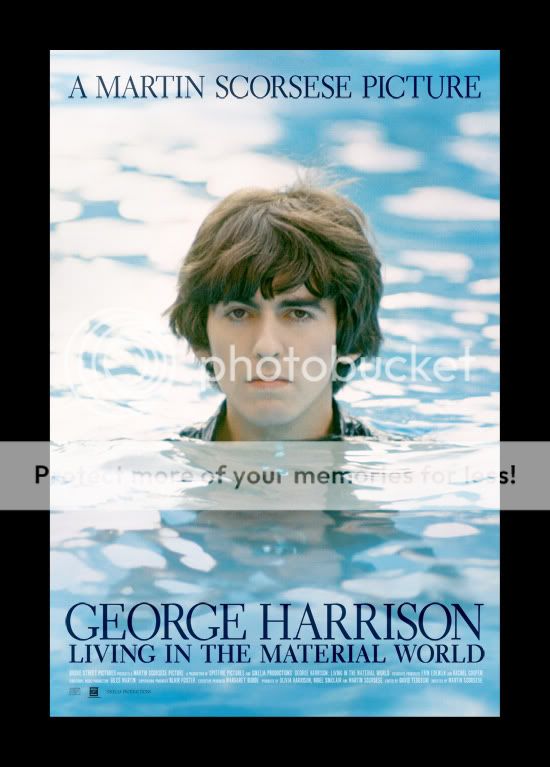
The past two nights I stayed up late watching parts 1 and 2 of Martin Scorsese's 4-hour documentary on the life of George Harrison. You know... the third most interesting Beatle.
The documentary is called "George Harrison: Living in the Material World." I am too young to know anything about Beatlemania that I can't learn from documentaries, but you know what? The third most interesting Beatle is still plenty fascinating.
It's a very long story, filled with anecdotes both familiar and surprising. So I'm going to mention just three things I learned while watching it.
1. Great people are great for a reason. People don't just fall into lives like Harrison's. They bring something special to the table when they enter the world. The record of such a life is more like a vapor trail behind some brightly burning, wondrous thing.
Laird Hamilton doing his impression of Beatlemania
from George Harrison's POV.
The secret of living well has often been compared to surfing, learning to ride the waves as they come, etc... Much of the beauty of this film comes through watching the powerful but naive young Beatle ride such titanic waves as came his way, as have famously damaged or outright crushed Elvises and Michaels in the past, only to reach the beach, and smile.
The life-as-surfing analogy is about balance. Inner life balanced with outer. We know Harrison's outer life. Scorsese gives four hours of his best work to offer us a strong hint at an indescribable counter-weight, the inner-life that afforded George Harrison such remarkable balance.
Through the narrative of the film, you can literally see it on Harrison's face as the intelligent, talented, but arrogant young man grows into the visage of a master, a sage. It's a slow motion jaw dropper.
--->>>
Harrison - taunting me.
2. Even as a remarkably handsome bald man, I guess I really am jealous of hair like that. Harrison looked awesome even with 70's Jesus Hair and managed to not look like a complete tool in the 80's. A truly amazing feat as those of you who came of age in the 80's already know (and if you don't know, look at some old pictures of yourself - you looked like a tool).
And finally, the last thing I think I learned and the reason for this blog post.
Harrison was a spiritual seeker. The good kind; the kind that leads by the example of their life, that doesn't tell other people what they are doing wrong, but seeks to slake their own insatiable curiosity, driven by the same desires we all seem to have been given at birth, but guided by a degree of control that lets desire lead to accomplishment, and ultimately to wisdom. This is the wisdom to realize that no matter how great the accomplishment (or the failure), it's really not a big deal in the grand scheme we all seem to be a part of. It's the wisdom to know we can all just relax, because there is really only one thing to do here that is important, and it's not as hard as surfing giant waves or being a Beatle.
From the story of George Harrison's life as presented by Martin Scorsese, I think I learned this...
3. If you want to know God, learn to love other people. Even if it's just one. That person is God. This is why we have friends, why we marry, why we have children. And it's probably why we have enemies too. Everyone is a gift to help us learn. And we are all in a position to do it. So keep practicing.
...you never really "got" what's so great about Humphrey Bogart.
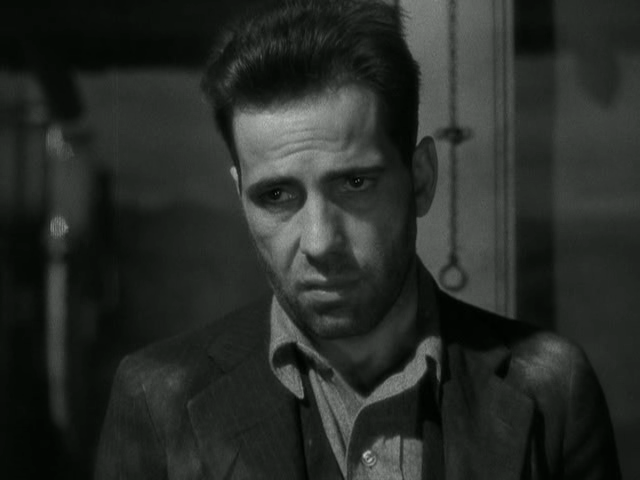
"The Maltese Falcon" 1941
Director: John Huston
Starring: Humphrey Bogart, Mary Astor, Peter Lorre, Sydney Greenstreet, Elisha Cooke Jr.
Like everybody in the world, I love “Casablanca.” But to be honest, there was a time, even after seeing that film, that I just didn’t “get” Humphrey Bogart. What was the big deal? For a “tough guy” he seemed small and frail, with a weak neck that needed help from starched collars to support his oversized head. He smoked filterless cigarettes, which is not only gross but also seemed to explain why he never chased the bad guys, and why his fight scenes rarely involved more than throwing one punch.
Then I saw “The Maltese Falcon.” Now, every time I notice that it’s on TV, I stop whatever I’m doing and watch ‘til the end. Have to. Too good. Too many new things picked up with each viewing. Incredible movie. And I attribute most of that awesomeness to its star. Bogey has been one of my favorite actors ever since.
What is so great, then, about Bogart as the enigmatic private eye, Sam Spade? There are two elements to Bogey and his performance here that, to me, really makes this film something special. The first is something an actor either has or doesn’t. Brains. The intelligence to play a character who is smarter than everybody in the room.
Dashiell Hammett is a smart writer who creates smart plots for smart characters who speak smart dialogue. Sam Spade would never tell you this, but he’s a bit of a genius, a gumshoe-savant, and whoever is playing him needs to convince you of that unspoken fact with every gesture and every twitch, or it won’t work. It certainly wouldn’t be as good as this movie, anyway. Now it’s true that any actor can probably play the world’s smartest scientist simply by putting on a lab coat and teasing up his hair. But you’ve got to bring a lot more than a London Fog overcoat and Fedora to play Sam Spade the way Bogart does.
“The Maltese Falcon” is about a detective who suddenly finds himself at the very end of a chase that has been going on for centuries. Imagine that you are dropped into a game of some kind. All you know about the game is that everyone but you knows the rules and the object, it’s played to the death, and it’s almost over. This is basically the situation for Sam Spade. So he has to play catch up... really fast. He’ll live or die by his ability to stay half-a-step ahead of every other character, including the cops who suspect him of murder. His only weapons then are his razor sharp mind and his rock-steady ability to bluff. Add to that equation the film’s low budget, long dialogue scenes that essentially play like a stage play instead of a movie, and you’ll see that the star’s ability to portray this character will either make or break the whole thing. The sheer intelligence that beams off of Bogart in this movie is almost like a special effect. He convinces us with his eyes, his long pauses, a smile, and of course his interpretation of the paragraph-sized chunks of dialogue, that Sam Spade is solving at least four different puzzles in his head while everything else is happening around him. This was not the first filmed version of “The Maltese Falcon.” It’s Bogart that separates this film not only from previous adaptations, but from every other film. He’s what makes it one of the best movies ever.
As the Villain in "The Petrified Forest" (1936)
Second, there is an undeniable “bad guy” quality to Humphrey Bogart that made him the ideal choice (even though producer Hal Wallis originally tried but failed to get George Raft) to play the morally ambiguous Sam Spade. Bogart had made a career out playing villains and heavies up until this point. So any nobility of character that Spade may eventually succumb to, never feels like a given. “One never knows what you’ll do, or why,” says the Fatman (Sydney Greenstreet).
Within hours of his partner Miles Archer’s death, Spade had their secretary, Effie, remove Archer’s name from the door. Which is a little awkward because the police suspect that Spade murdered Miles so he could continue an affair with his wife. Which, of course, isn’t true because, although he IS sleeping with Mrs. Archer, Spade can’t stand her. He uses Effie, who he’s also apparently sleeping with*, to run interference for him. And yet... somehow he is the good guy.
That constant undercurrent that he is capable of anything is also what really stirs the drink in “Casablanca.” Both films even end in a similar way, where the decision Bogey must make - to be noble or selfish, good guy or bad, has us on the edge of our seats. That doesn’t work if the actor can’t make us wonder what he’s capable of, or what his idea of a happy ending might even be. The dialogue at the end of Casablanca, “the troubles of two people...” is some of the most famous in movie history. But Sam Spade’s speech to Brigid O’Shaughnessy at the end of “The Maltese Falcon,” taken directly from the pages of Hammett’s book, is some of the all time best.
Humphrey Bogart delivered in both cases.
Apparently there was sex in 1940's, just not in the movies.
That's what sub-text is for. And paperback book covers.
*A fun note on sex in “The Maltese Falcon.” According to the movies in 1941, people did not have sex. So there is a code to this film. Anytime Bogie calls a woman, “Darling,” it means they’ve had sex at some point. The scene where Effie sensually rolls him a cigarette makes their relationship pretty clear, but when he calls her Darling... you can be sure. You’ll see the secret code most clearly after the scene where it seems like he and Mary Astor are about to... we fade out, and when we come back, suddenly they are both “Darling.”
New post - Read how The Maltese Falcon influenced my contemporary fantasy, King’s X. Click HERE
The anecdote on the big yellow stationary also appears in the first pages of Ray Bradbury's "Zen in the Art of Writing." I recommend that book to anybody who wants to be a writer.
But I recommend this simple advice to anyone who wants to be happy in their work, and really in their life. It would be awesome if we could all figure this out at age 9, but we can also jump in at any time.
The typos - "Who die(d)?"- are particularly cool because they are legitimate typos... as in made on a typewriter. Because even in 1991, Ray Bradbury, the master of science fiction, did not use a computer. Why not? Because he's Ray Bradbury! If you draw your own awesome stationary with a ballpoint pen like that then you can do whatever you want too.